Hong Kong rental pressure (2000-2025)
Background
Hong Kong, a metropolis with thriving economy, has attracted many migrants. Due to ‘High Talent Pass Program’ and relaxation of quota restrictions for non-local students in Hong Kong, more potential tenants are flocking in, facing the severe challenge of rental pressure because of Hong Kong’s limited land area and high population density. Rencently, the issue of rising rents is becoming increasingly severe, according to a report from South China Morning Post.
Regarding this prominent livelihood issue in Hong Kong, this project aims to visually illustrate rental affordability pressures across different years, age groups, and districts within Hong Kong by comparing rent to income.
Questions to answer
- How have rents for small and medium-sized housing units in Hong Kong changed year by year?
- How rental pressures differ across age groups?
- What is the relationship between rent in Hong Kong’s three regions and the income?
- How has rental pressures in Hong Kong’s three regions changed by years?
Data source
The data on average rent of private residences by unit type is sourced from Real Estate Market Statistics from Rates and Valuation Department
The data on median monthly employment income of employed persons by age and sex is sourced from Hong Kong Special Administrative Region Government Census and Statistics Department
Summary of findings
1. Rent for small homes increased at a faster rate than that for medium-sized homes
As we can see in the line chart, the average rent (HK dollars per square foot) for the two housing types from 2000 to 2010 is nearly identical. However, rent increases for small apartments have been rising significantly faster than those for medium-sized units since 2011, with the gap between them widening.
This increase is mainly because that Hong Kong’s core tenants for compact apartments include highly paid professionals, cross-border commuters, and mainland students. They prioritize commuting convenience over spacious living. Thus, the demand for small-size housing unit has increased, driving up rents.
2. Young people and the elderly bear significantly greater rental pressures than other age groups
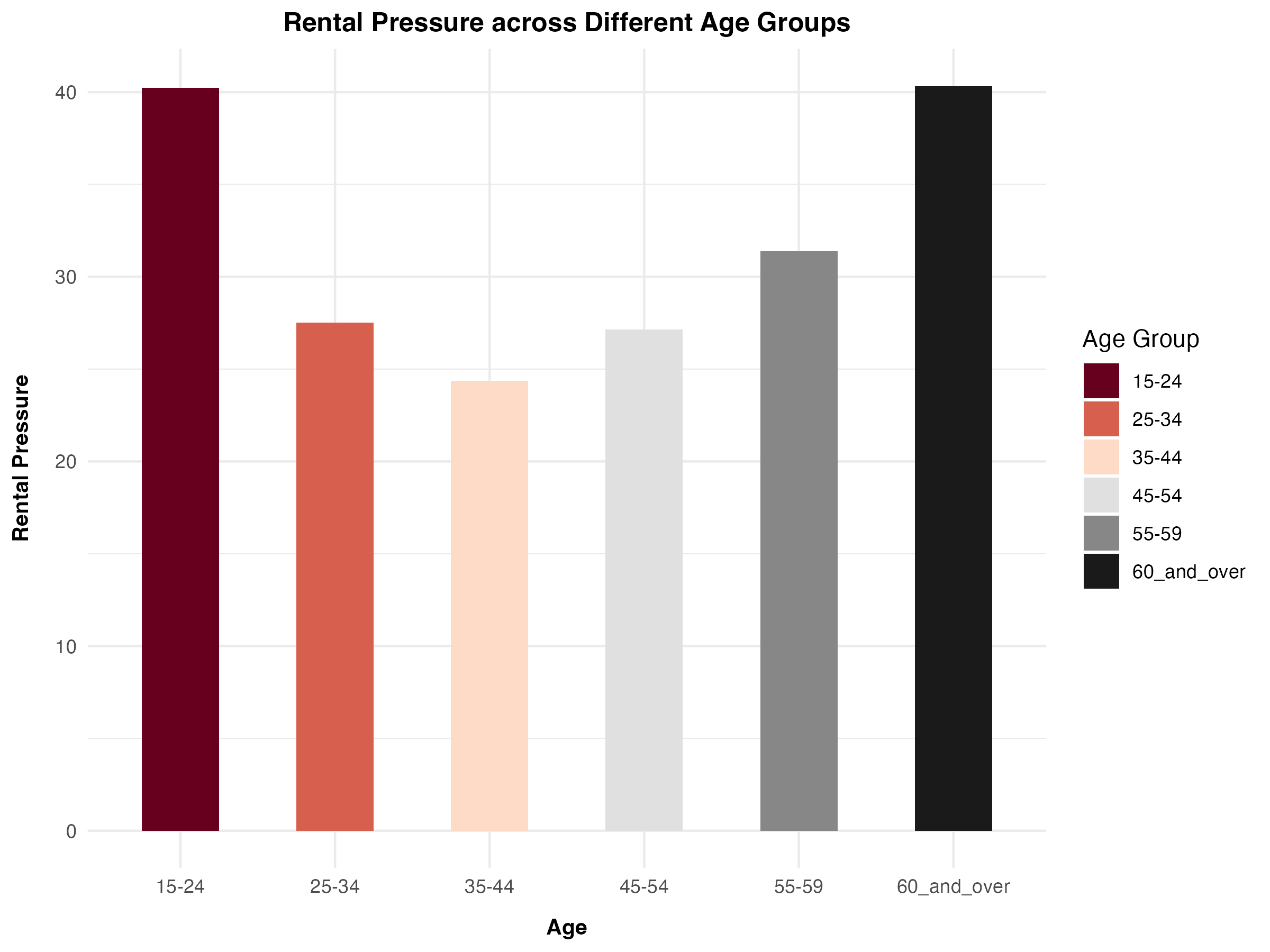
This bar chart shows how rental pressure differs across different age groups. Two age groups, 15-24 and over 60, obviously have higher rental pressure compared to others. Facing same rental prices, they have lower income, which leads to higher economic burdens on them. Young faculty members, international students and elderly without housing suffer most. The Hong Kong government and universities also provide rental subsidies for students, while the government offers public housing assistance programs for the elderly, implementing rent reductions.
Compared to these two age groups, age 35-44 bear least rental pressure, which is potentially related their stable career development.
3. What is the relationship between rent in Hong Kong’s three regions and the income?
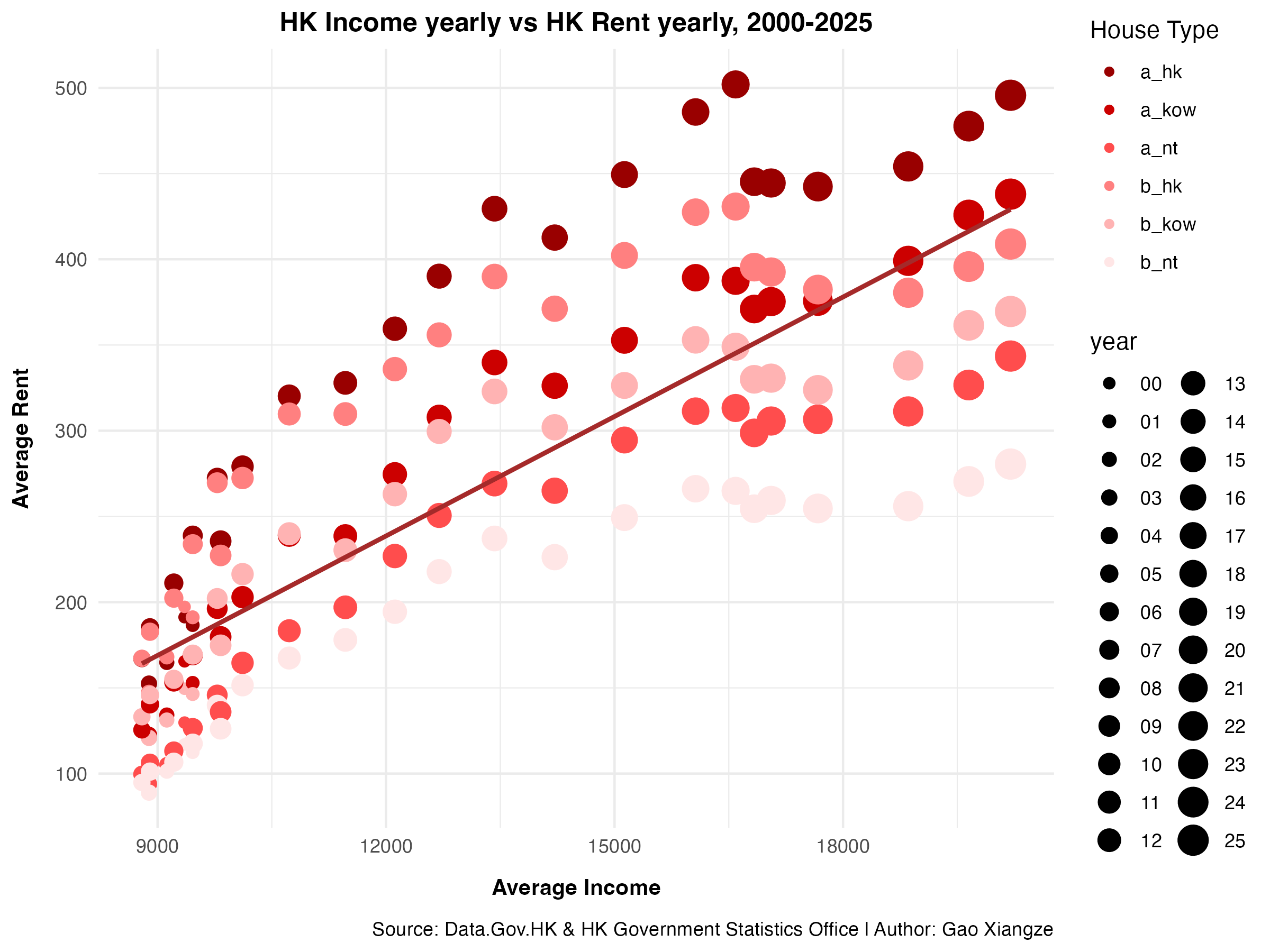
Average income and average rent have generally increased in tandem from 2000 to 2025.
Rent for housing units on Hong Kong Island and small units in Kowloon is significantly higher among the six housing types. Moreover, the rate of increase in rent is faster than that of income growth (as determined by the slope).
The rent growth rate of small housing units on Hong Kong Island outpaces the growth rate of average incomes most significantly.
In contrast, rent increases in the New Territories showed the slowest growth relative to average income growth, regardless of property type.
4. How has rental pressures in Hong Kong’s three regions changed by years?
For all housing types, rental pressure reached its lowest point in 2003 and peaked in 2015. In 2003, the SARS outbreak let the economy suffered a severe blow, and rental demand plummeted, resulting in low rent. While in 2015, with the development of economy, high rental demand driven by sky-high property prices and shortage of new housing units caused by land supply constraints all boost rental pressure of this year.
Overall, tenants of housing units on Hong Kong Island bear the heaviest rental pressure.
Year 2022 marked a turning point, as rent for small housing units in Kowloon began to exceed those for medium-sized homes on Hong Kong Island. It implies the result of “Northern Metropolis” strategy in 2021, which has enhanced Kowloon’s connectivity, attracting mainland-related enterprises and talent. Also, a influx of single professionals and small families—budget-conscious yet prioritizing commute and amenities—flocked to the area. This surge in demand for compact, well-located units in Kowloon sharply drove up rents for smaller properties, surpassing those of mid-sized units on Hong Kong Island.
Regarding the pressing concern of current rental pressures, it is evident that these pressures are at a moderate level compared to the past twenty-five years, but they are projected to rise steadily and gradually in the future.
Conclusion
The development status of different regions, government policies across various periods, and major historical events collectively influence Hong Kong’s rental pressure. Through the evolution of this pressure, we can also observe the transformations within Hong Kong society over the past twenty-five years.